
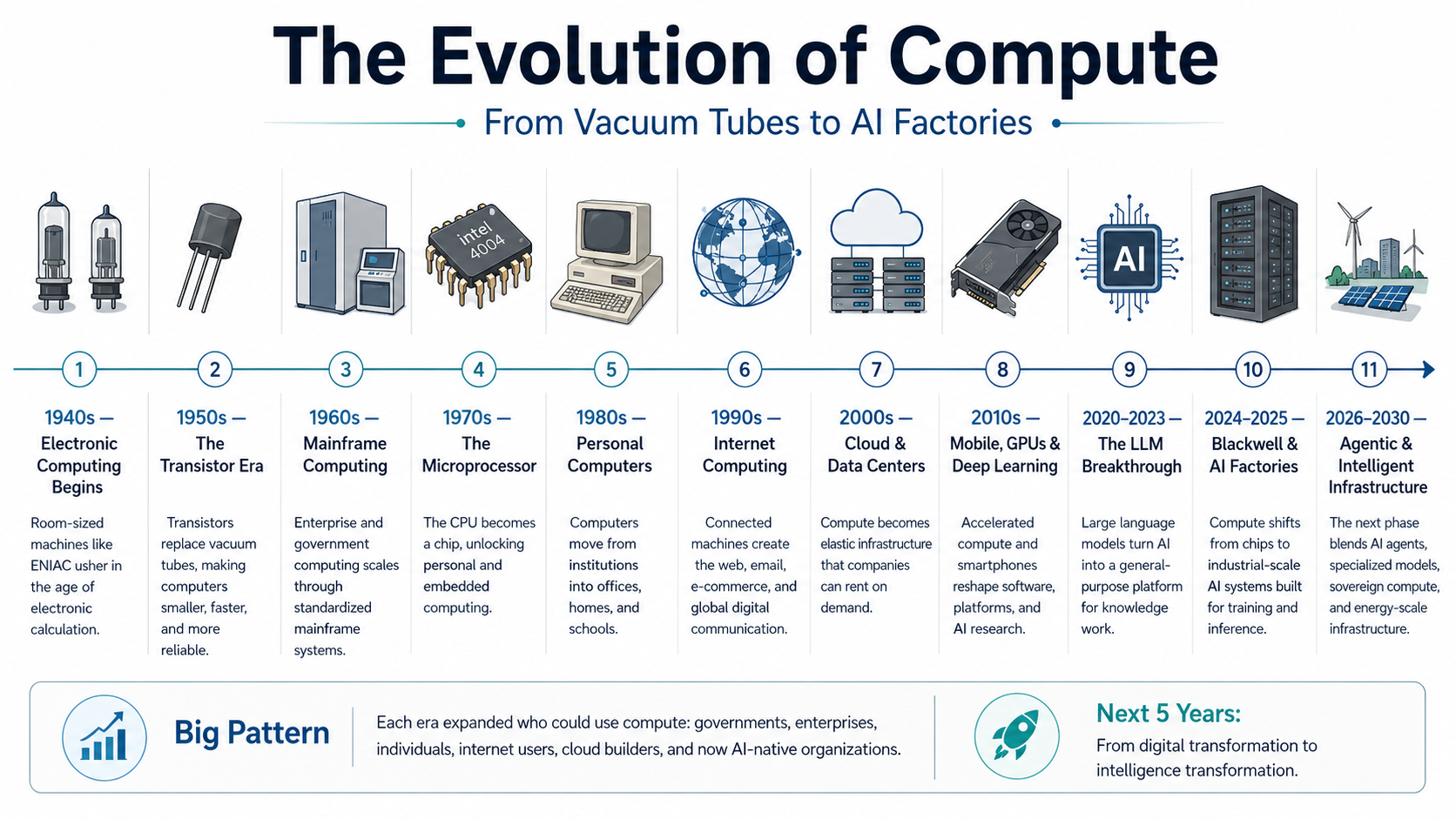
We are no longer just improving computers; we are building industrial compute infrastructure the way earlier eras built power plants, railways, factories, and telecom networks.
Here is the historic rundown.
1. 1940s: The birth of electronic computing
The early computer age began with machines like ENIAC, built during World War II. It was not a “computer” in the laptop sense. It was a room-sized electronic calculator for military and scientific work. ENIAC used around 18,000 vacuum tubes, occupied more than 1,000 square feet, and weighed around 30 tons. It was over 1,000 times faster than earlier electromechanical machines. (CHM)
The key shift here was:
manual calculation → electronic calculation
Computers were rare, expensive, and used mostly by governments, universities, and militaries.
2. 1950s: Vacuum tubes to transistors
The first computers were powerful but fragile. Vacuum tubes consumed huge power, generated heat, and failed often.
Then came the transistor, which changed everything. Transistors made computers smaller, more reliable, more energy efficient, and commercially viable.
The key shift was:
giant fragile machines → smaller reliable machines
This is when computing started moving from pure research labs into business and government operations.
3. 1960s: Mainframes and enterprise computing
The 1960s were the age of the mainframe. The most important symbol was IBM System/360, launched in 1964. It was designed as a compatible family of machines for different types of users and workloads. IBM says System/360 replaced multiple old product lines with one compatible architecture and helped establish the 8-bit byte that is still foundational today. (IBM)
The key shift was:
custom machines → standardized enterprise computing platforms
This is where computing became serious business infrastructure: banking, airlines, insurance, government records, payroll, accounting, logistics.
4. 1970s: The microprocessor changes everything
In 1971, Intel introduced the 4004, one of the most important breakthroughs in computing history. Intel describes it as a programmable logic microchip and one of the most important conceptual breakthroughs of the 20th century. (Intel)
The key shift was:
computer as a room → computer as a chip
This is the beginning of the personal computer revolution. Once the CPU became a chip, computing could move into calculators, industrial machines, cars, offices, homes, and eventually phones.
5. 1980s: The personal computer era
The 1980s made computing personal. IBM PCs, Apple machines, Microsoft DOS and later Windows turned computers into office and home productivity tools.
The key shift was:
centralized enterprise compute → personal productivity compute
This created the software industry as we know it: spreadsheets, word processors, desktop publishing, databases, games, and business applications.
This is when the computer became a tool for individuals, not just institutions.
6. 1990s: Internet computing
The 1990s connected computers together. The internet and the World Wide Web turned isolated machines into a global information network.
The key shift was:
standalone computers → connected computers
This created browsers, websites, search engines, email, e-commerce, online advertising, and the first wave of digital platforms.
Compute was no longer just about processing. It became about communication, publishing, discovery, and transactions.
7. 2000s: Data centers and cloud computing
In the 2000s, companies like Amazon, Google, Microsoft, and later others started turning computing into a utility.
Instead of buying servers, companies could rent compute, storage, and databases on demand.
The key shift was:
owning servers → renting elastic infrastructure
This created the cloud era. Startups could launch globally without buying hardware. Enterprises could scale faster. Software moved from installed products to SaaS.
This is also when large-scale data centers became strategic assets.
8. 2010s: Mobile, GPUs, and deep learning
The 2010s had three major compute revolutions at once.
First, the smartphone put powerful compute in everyone’s pocket.
Second, cloud platforms matured.
Third, GPUs became critical for AI.
Originally, GPUs were designed for graphics and gaming. But because they are excellent at parallel math, they became ideal for deep learning. Neural networks need massive matrix calculations, and GPUs are built for that type of work.
The key shift was:
CPU-centric compute → accelerated compute
This is the decade where AI moved from academic promise to commercial reality: image recognition, speech recognition, recommendation engines, autonomous driving research, and early large language models.
9. 2020–2022: The large language model breakthrough
This is where the modern AI era begins.
The transformer architecture, massive datasets, large GPU clusters, and cloud infrastructure came together. Models became good enough to generate language, code, images, video, and reasoning-like outputs.
NVIDIA’s Ampere A100 and then Hopper H100 became central to this era. Hopper introduced the Transformer Engine, designed specifically to accelerate transformer workloads. NVIDIA says Hopper was built for next-generation AI workloads with massive compute and fast memory, and that its Transformer Engine helps train large models in days or hours. (NVIDIA Blog)
The key shift was:
AI as a feature → AI as a platform
This is when AI stopped being a small module inside software and became the foundation for new products, workflows, and business models.
10. 2023–2024: The GPU becomes the new oil
After ChatGPT exploded, the world realized that the limiting factor for AI was not just algorithms. It was compute capacity.
The H100 became one of the most valuable pieces of enterprise hardware in the world because everyone needed it: OpenAI, Microsoft, Google, Meta, xAI, Amazon, startups, sovereign AI programs, banks, governments, and research labs.
The key shift was:
software scarcity → compute scarcity
Whoever controlled GPUs, power, cooling, data centers, networking, and talent had a strategic advantage.
This is why NVIDIA became one of the most important companies in the world.
11. 2024–2025: Blackwell and the AI factory era
Blackwell is important because it is not just a better chip. It represents a new design philosophy.
NVIDIA says Blackwell GPUs have 208 billion transistors, are manufactured using a custom TSMC 4NP process, and use two reticle-limited dies connected by a 10 TB/s chip-to-chip interconnect, behaving as one unified GPU. (NVIDIA)
Blackwell also supports lower-precision formats such as FP4/NVFP4 for inference efficiency, which matters because the AI world is shifting from only training models to serving billions or trillions of inference requests. NVIDIA’s Transformer Engine documentation says Blackwell supports MXFP8 and NVFP4 formats for greater efficiency. (GitHub)
The key shift is:
training powerful models → operating AI at industrial scale
That is why the phrase AI factory matters. A traditional factory turns raw material into products. An AI factory turns data, electricity, models, and GPUs into intelligence outputs: answers, decisions, code, designs, predictions, videos, agents, and automations.
NVIDIA and major computer manufacturers have explicitly positioned Blackwell systems as infrastructure for enterprises to build AI factories and data centers. (NVIDIA Newsroom)
12. 2025–2026: From chip-scale to rack-scale computing
The latest shift is that compute is no longer thought of as a single chip, or even a single server.
It is now designed at the rack scale and data center scale.
The new unit of computing is becoming the full AI system: GPUs, CPUs, memory, networking, cooling, storage, software, security, orchestration, and energy.
NVIDIA’s next Rubin platform, announced in 2026, is positioned as a full AI supercomputing platform rather than just a GPU. NVIDIA says Rubin is designed with hardware and software codesign and aims to reduce inference token cost and reduce the number of GPUs needed for certain large model training workloads compared with Blackwell. (NVIDIA Newsroom)
The key shift is:
chips → systems → factories → national infrastructure
This is why governments now talk about sovereign AI. Countries want their own compute capacity the way they want energy security, food security, financial infrastructure, and defense capability.
The full compute timeline in one view
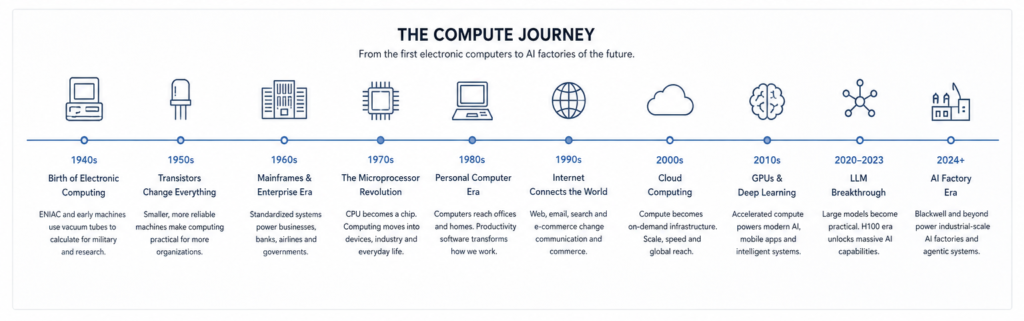
| 1940s | ENIAC/vacuum tube machines | Electronic calculation begins | Military, government, research |
| 1950s | Transistor computers | Smaller, more reliable machines | Government, universities, large companies |
| 1960s | Mainframes | Enterprise computing standardizes | Banks, airlines, insurers, governments |
| 1970s | Microprocessors | CPU becomes a chip | Electronics, industry, early PCs |
| 1980s | Personal computers | Computing reaches individuals | Offices, homes, schools |
| 1990s | Internet-connected PCs | Global communication and publishing | Consumers, businesses, media |
| 2000s | Cloud data centers | Compute becomes rentable infrastructure | Startups, enterprises, platforms |
| 2010s | GPUs + mobile + cloud | Accelerated compute powers AI | Big tech, AI labs, app platforms |
| 2020–2023 | A100/H100 clusters | LLMs become commercially usable | AI labs, cloud providers, enterprises |
| 2024–2025 | Blackwell systems | AI factories become the new infrastructure | Hyperscalers, governments, Fortune 500 |
| 2026 onward | Rubin/rack-scale AI systems | Full-stack AI supercomputing | Nations, platforms, large enterprises |
The big pattern
Every major compute era has changed who can do what.
First, computers helped governments calculate faster.
Then they helped enterprises process records.
Then PCs helped individuals create work.
Then the internet helped people connect.
Then cloud helped companies scale.
Then GPUs helped machines learn.
Now AI factories will help organizations produce intelligence at scale.
That is the real meaning of Blackwell. It is not only a chip story. It is a story about compute becoming the next industrial base.
The next winners will not only be companies with better software. They will be companies, cities, and countries that control:
compute + data + energy + models + distribution + trust.
The Real picture
However, the world does not move through technology eras evenly. Some countries, companies, and individuals are already entering the AI factory / agentic automation era, while others are still operating at the level of basic digitization, spreadsheets, manual approvals, disconnected CRMs, and paper-heavy workflows.
So the real picture is not “the world has moved to AI.”
The real picture is:
Different parts of the world are living in different compute eras at the same time.
Some are in the cloud era.
Some are in the SaaS era.
Some are in the mobile-first era.
Some are just entering structured digital transformation.
Some are experimenting with AI.
And a very small minority are building AI-native operating models.
Is maturity going to take decades?
Yes, for full maturity, most likely multiple decades.
Not because the technology will take decades. The technology is moving very fast. The slower part is:
people, processes, governance, capital allocation, regulation, education, trust, data readiness, and organizational redesign.
AI capability may double quickly. But an enterprise does not transform just because a better model exists. A government department, a bank, a real estate developer, a school system, or a logistics company needs to change its data, workflows, roles, risk policies, vendor stack, operating model, and leadership mindset.
That is why technology progress and adoption progress are different curves.
A country can buy GPUs in one year.
A company can buy licenses in one quarter.
But becoming truly AI-native may take 5, 10, 15, or 20 years.
The maturity gap will become the main story
The next five years will not be about “AI replacing everything.”
The next five years will be about the gap between:
AI-capable organizations
and
AI-confused organizations.
The leaders will not simply be the ones using ChatGPT or Microsoft Copilot. The leaders will be those who rebuild their workflows around intelligence, automation, and data.
The laggards will use AI as a tool.
The leaders will use AI as infrastructure.
That is a very different game.
The maturity ladder
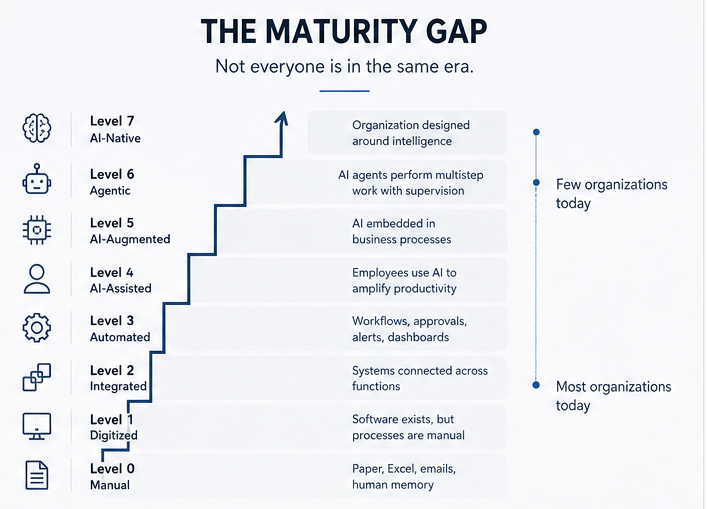
A simple way to see the world:
| Level 0 | Manual | Paper, WhatsApp, Excel, human memory |
| Level 1 | Digitized | Software exists, but processes are still manual |
| Level 2 | Integrated | CRM, ERP, finance, support, portals, BI are connected |
| Level 3 | Automated | Workflows, approvals, alerts, dashboards, integrations |
| Level 4 | AI-assisted | Employees use AI for writing, analysis, coding, summaries |
| Level 5 | AI-augmented | AI is embedded inside business processes |
| Level 6 | Agentic | AI agents perform multistep work with human supervision |
| Level 7 | AI-native | The operating model is designed around data, agents, automation, and continuous intelligence |
Most companies today are somewhere between Level 1 and Level 4.
A few global leaders are moving toward Level 5 and Level 6.
Very few are truly Level 7.
What the next 5 years will probably look like
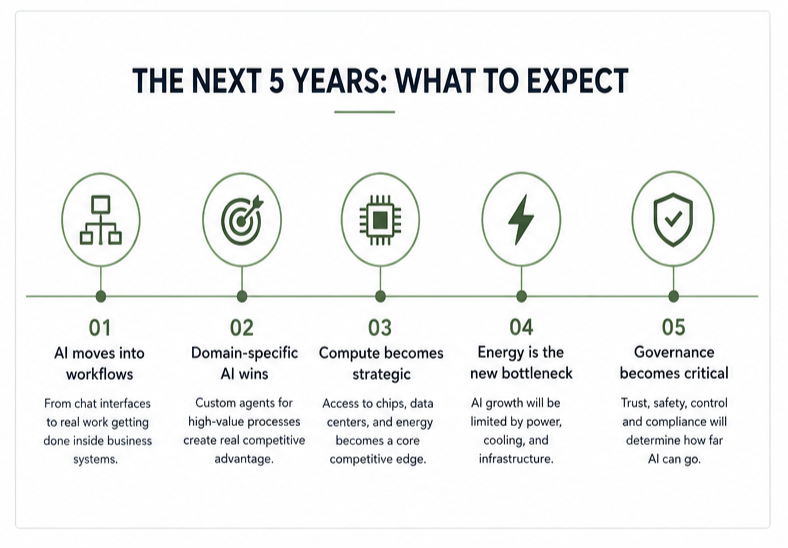
1. AI will move from chat interfaces to business workflows
Today, many people experience AI as a chat window. That is only the beginning.
Over the next five years, AI will increasingly sit inside CRMs, ERPs, call centers, development tools, supply chain platforms, finance systems, HR systems, healthcare platforms, and government services.
The important shift will be:
from “ask AI a question” to “AI completes part of the work.”
McKinsey’s 2025 technology outlook specifically identifies agentic AI as one of the fastest-growing technology trends, describing it as AI that can autonomously plan and execute multistep workflows through “virtual coworkers.” (McKinsey & Company)
This means AI will not only summarize meetings. It will create follow-ups, check data, update CRM fields, prepare proposals, raise tickets, validate documents, compare contracts, and trigger workflows.
2. The winning companies will build process-specific AI, not generic AI
Generic AI will become common. Everyone will have access to writing assistants, research assistants, coding assistants, and meeting summarizers.
The real advantage will come from domain-specific AI systems.
For example:
A real estate developer will need AI for inventory, broker productivity, collections, handover, customer service, maintenance, and project progress.
A bank will need AI for risk review, customer onboarding, compliance, fraud, relationship management, and collections.
A retailer will need AI for site selection, demand forecasting, pricing, merchandising, store performance, and customer loyalty.
A construction company will need AI for BOQ review, progress tracking, contract claims, procurement, safety, and cost control.
McKinsey argues that the real potential of agentic AI will require custom-built agents for high-impact processes, deeply aligned with a company’s logic, data flows, and value creation levers. (McKinsey & Company)
That is a very important point. The future is not one giant AI that magically understands every business. The future is many specialized agents connected to real business systems.
3. Compute will become a strategic resource
In the past, companies competed on software. Now, large companies and countries will increasingly compete on compute access.
The Stanford AI Index 2025 notes that inference costs for GPT-3.5-level performance dropped more than 280-fold between November 2022 and October 2024, while hardware costs declined around 30% annually and energy efficiency improved around 40% annually. (Stanford HAI)
This means AI will become cheaper and more accessible at the application level.
But at the frontier level, the opposite is also true: the largest models, biggest AI factories, and most advanced systems will require enormous capital, power, cooling, networking, and chips.
So we will see two realities at once:
AI becomes cheaper for users.
AI infrastructure becomes more strategic and expensive for leaders.
That is why hyperscalers, governments, and large enterprises are investing in AI data centers and AI factories.
4. Energy will become a bottleneck
The next AI race will not only be about chips. It will also be about electricity.
The International Energy Agency projects that global data center electricity consumption could more than double to around 945 TWh by 2030, with AI being a major driver of that growth. (IEA)
That is a major structural shift. AI infrastructure will need power, land, cooling, grid connectivity, water planning, and renewable energy strategies.
So the future AI stack is not just:
model + data + software
It is:
model + data + software + chips + power + cooling + real estate + regulation + capital.
This is why AI is becoming industrial infrastructure.
5. Small models and edge AI will become more important
Not everything will run on massive frontier models.
Because inference cost, latency, data privacy, and control matter, companies will increasingly use smaller, specialized, efficient models. Some will run in private clouds. Some will run on-premise. Some will run at the edge, closer to devices, factories, stores, vehicles, cameras, and sensors.
The Stanford AI Index also notes that open-weight models are narrowing the gap with closed models, with the performance gap on some benchmarks shrinking significantly in a single year. (Stanford HAI)
This matters because it means more countries and companies may not need to depend fully on a few closed model providers. They can build private, controlled, domain-specific AI systems.
The likely architecture will be hybrid:
large frontier models for complex reasoning
plus
small specialized models for repetitive high-volume tasks
plus
workflow agents connected to enterprise systems.
6. AI agents will be useful, but governance will become critical
The next five years will see a lot of agentic AI demos. Some will be impressive. Some will fail badly.
The reason is simple: giving AI the ability to act creates risk.
An AI that writes a paragraph is low risk.
An AI that updates customer records, sends emails, approves invoices, changes pricing, or triggers payments is a different matter.
So the next phase will require:
clear permissions, audit logs, human approvals, data boundaries, exception handling, cybersecurity, identity controls, rollback options, and compliance frameworks.
The organizations that win will not be the ones that let AI do everything. They will be the ones that design the right balance between:
automation, control, trust, and accountability.
7. The job market will split into AI-amplified and AI-exposed roles
The simplistic idea is “AI will take jobs.”
The more realistic view is:
AI will change the value of tasks before it changes the existence of jobs.
People who can use AI to produce better work faster will become more valuable. People whose work is repetitive, undocumented, and easy to automate will face pressure.
The most valuable employees will be those who can combine:
business understanding, domain knowledge, process thinking, data literacy, AI fluency, communication, judgment, and governance awareness.
The next five years will reward people who can say:
“I understand the business process, and I know how to redesign it with AI.”
That is a much more powerful skill than just prompt writing.
My POV: the next 5 years
Here is the clean point of view:
We are entering the transition from digital transformation to intelligence transformation.
For the last 20 years, companies digitized their operations. They moved from paper to software, from local servers to cloud, from manual reporting to dashboards, from disconnected teams to integrated platforms.
But most of that transformation still required humans to operate the system.
Humans entered the data.
Humans checked the reports.
Humans wrote the emails.
Humans followed up.
Humans reconciled exceptions.
Humans made sense of the system.
The next phase is different.
Now the system itself starts to reason, recommend, draft, validate, act, monitor, escalate, and learn.
That does not mean humans disappear. It means the human role moves upward.
From doing every step
to designing the system.
From checking every record
to handling exceptions.
From manually coordinating
to supervising intelligent workflows.
From operating software
to orchestrating digital labor.
The world will not transform evenly
This is the most important point.
The AI future will not arrive everywhere at once.
Some countries will lead because they have capital, compute, energy, policy, education, and private-sector ambition.
Some companies will lead because their CEOs understand that AI is not an IT project. It is an operating model shift.
Some individuals will lead because they will continuously learn, experiment, and use AI to multiply their output.
Others will lag because they will treat AI as a trend, a chatbot, a cost-saving tool, or a side experiment.
The gap between leaders and laggards may become wider than the gap created by the internet.
Because AI does not just improve communication.
It improves decision-making, execution speed, creativity, software creation, analysis, and operational leverage.
That is why the next five years are so important.
What leaders should do now
For companies, the practical roadmap is:
- Fix the data foundation
No AI strategy works if the data is scattered, dirty, inaccessible, or politically owned by departments. - Map high-value processes
Do not start with “where can we use AI?” Start with “where do we lose time, money, quality, speed, or customer trust?” - Build AI into workflows, not just tools
AI should not sit outside the business process. It should be embedded into CRM, ERP, support, sales, finance, operations, and customer journeys. - Create governance early
Permissions, approvals, audit trails, data security, and human-in-the-loop rules must be designed from the beginning. - Train people by role
A CFO, sales manager, developer, HR manager, and customer service agent do not need the same AI training. - Start with narrow, valuable use cases
The first AI wins should be specific: proposal generation, lead qualification, invoice validation, support triage, project reporting, customer follow-up, document comparison, compliance review. - Build internal AI capability
Companies should not outsource all AI thinking. They need internal owners who understand both business and technology.
The likely 5-year outcome
By 2030, we will likely see this world:
AI will be inside almost every major software product.
Every serious enterprise will have some form of AI governance policy.
Many companies will have internal AI agents for sales, finance, HR, IT, procurement, legal, customer service, and operations.
AI infrastructure will become a board-level and national-level topic.
Data centers, energy, chips, and cloud contracts will become strategic business decisions.
Small businesses will get access to powerful AI through SaaS products, but large companies will build more private and domain-specific systems.
The productivity gap between AI-native teams and traditional teams will become visible.
And the biggest winners will not be those who “use AI.”
The biggest winners will be those who redesign their organization around intelligence.
Connect with us if you are exploring how to redesign your organization around intelligence.
